
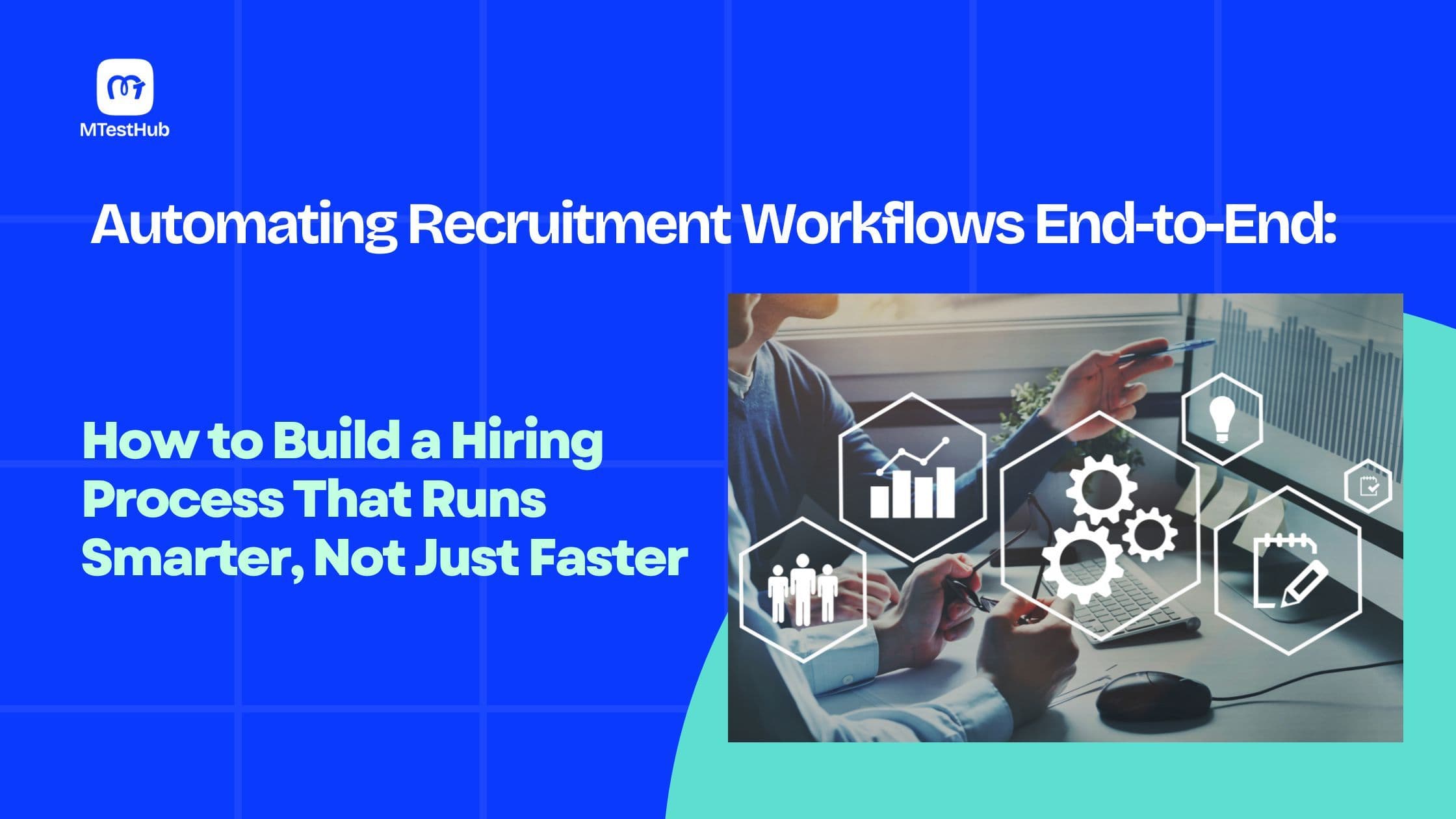
How to build a smarter and faster hiring process through end-to-end recruitment workflow automation.
Your recruitment process leaks, and it is probably not where you think.
It is not the job boards. It is not the salary benchmarks. It is not even the shortage of qualified candidates, though these are real, too. The leak is quieter than all of that.
It is the three hours a hiring manager loses every Thursday to resume screening, the confirmation emails sent one by one, the offer letter still stuck in an approval chain because two sign-offs are traveling, and the interview feedback that wasn’t submitted because nobody followed up.
By the time you add it up across every open role, every quarter, the picture becomes uncomfortable: your best hiring decisions are being made by people who spent most of their day doing things a system could have handled before lunch.
That is the real and unglamorous problem recruitment automation solves. Let's dive more into it in this article.
Most companies designed their hiring process when they were smaller, slower, and had more time. One or two hires a month. Enough breathing room to be thorough. Enough margin to recover from a wrong decision.
That process does not scale. And in the UAE (where hiring demand is forecast at 64% positive across key sectors in 2026, and over 500,000 job openings are expected annually) volume is exactly what companies are dealing with.
When volume increases and the process stays the same, one of two things happens. Either speed suffers, roles stay open too long, top candidates accept other offers, and teams carry the shortfall. Or quality suffers, under pressure to fill seats fast, leading to shortcuts: skipped assessments, reduced interview panels, offers made on gut feel.
Both outcomes are expensive. A role left open too long creates measurable productivity loss. A bad hire costs between 50% and 150% of that employee's annual salary by the time replacement is factored in.
The solution is not to hire faster. It is to build a process that handles volume without sacrificing standards.
End-to-end recruitment automation means connecting every stage of the hiring workflow, from role approval to signed contract, so that the system handles what does not require human judgment and frees your team to focus on what does.
Here is what that looks like in practice.
Posting and sourcing stop being a manual task. One standardized listing pushes to every relevant platform simultaneously. Applications feed into a single pipeline. Source tracking tells you which channels are worth your budget and which are not.
Resume screening shifts from a subjective skim to a structured filter. Defined criteria sort candidates against the actual requirements of the role, not against a hiring manager's mental template or whatever impression a CV makes in forty-five seconds. The shortlist your team receives is built on fit, not fatigue.
Candidate communication runs on its own. Every applicant gets timely, professional updates from applications to job offers automatically. In a market where strong candidates are fielding multiple approaches at once, response speed is not just courtesy; it is a competitive signal. Companies that communicate slowly tell candidates exactly how they operate before the interview even starts.
Interview scheduling goes from a three-day email chain to a three-minute self-selection. Candidates pick from available slots that sync directly with panel calendars. Confirmations, reminders, and rescheduling happen without a single manual message.
Before going further, this needs to be said plainly: automation is not a replacement for the human side of hiring. It is a protection of it.
The final interview, where a hiring manager assesses whether a candidate will thrive on this team, under this leadership style, at this stage of the company, cannot be handed off to an AI or automated agent.
Neither can the judgment call on culture fit, growth potential, or the instinct that something is off despite a strong assessment result.
The companies that over-automate end up with fast, consistent, empty processes. They move candidates through stages efficiently and still make poor hiring decisions, because they removed human judgment from places where it was still needed.
The goal is precision, not replacement. Automate where a human adds no value, preserve human judgment where it is the point.
Here is where most automated recruitment systems have a blind spot. Between resume screening and the interview, there is a stage that many companies either skip entirely or handle inconsistently: candidate assessment. And without it, the interview stage is doing work it was never designed to do.
Interviews are good at revealing how a person communicates, how they think under pressure, and whether they fit the team. But they are poor at reliably measuring what a a candidate can actually do.
A confident, well-prepared candidate can perform well in an interview while being genuinely unqualified for the role, while an outstanding candidate who interviews nervously gets filtered out before they get a chance to prove themselves.
When assessment is missing, the interview carries the full weight of the hiring decision. That is too much to ask of a one-hour conversation, and the mis-hire rate reflects it.
MTestHub sits at exactly the stage most automated recruitment systems leave exposed.
When a candidate reaches the assessment stage in your pipeline, MTestHub delivers role-specific pre-employment tests automatically the candidate’s technical skills, cognitive ability, situational judgment, and domain knowledge and scores them immediately. Results feed back into your hiring workflow before a single interview is scheduled.
What this does to the process is significant. By the time the hiring manager gets to the interview, they sit down with a shortlisted candidate, and they already know what that person can do. The interview becomes a conversation about fit and context, not a discovery session about basic competence. Confidence in those decisions increases, and it's easier to make them.
It also brings something that high-volume hiring tends to lose: consistency. When ten hiring managers are screening across twenty roles simultaneously, standards drift. Assessments do not. Every candidate is measured against the same criteria in the same way, regardless of who is running the process on a given day.
For companies with Emiratisation targets, this consistency matters even more. MTestHub evaluates every candidate, both local and international, against the same objective standard. The best person gets the role, every time, with the data to show it.
A recruitment process that runs on manual effort has a limit. It can only move as fast as the people operating it, and it gets worse under pressure, which is precisely when hiring matters most.
End-to-end automation removes that ceiling. It handles the volume, maintains the consistency, and gives your hiring team back the thing they need most: time and clarity to make decisions that actually hold up.
MTestHub ensures that quality does not get lost in efficiency. Fast hiring is only valuable if it produces the right hire. MTestHub makes sure it does. Your next great hire is already in your pipeline. MTestHub helps you find them.
Book a free demo now to see how it works.
Be the first to know the latest hiring trends, product updates, and exclusive tips to streamline your recruitment process by joining our newsletter.


Streamlining Recruitment, Assessments, and Exams with AI-driven automation.
We use cookies to improve your experience. By continuing, you consent to their use. Do you accept?