
See how transcript-first AI evaluation can make video responses more explainable, reviewable and job-related while keeping humans in control.
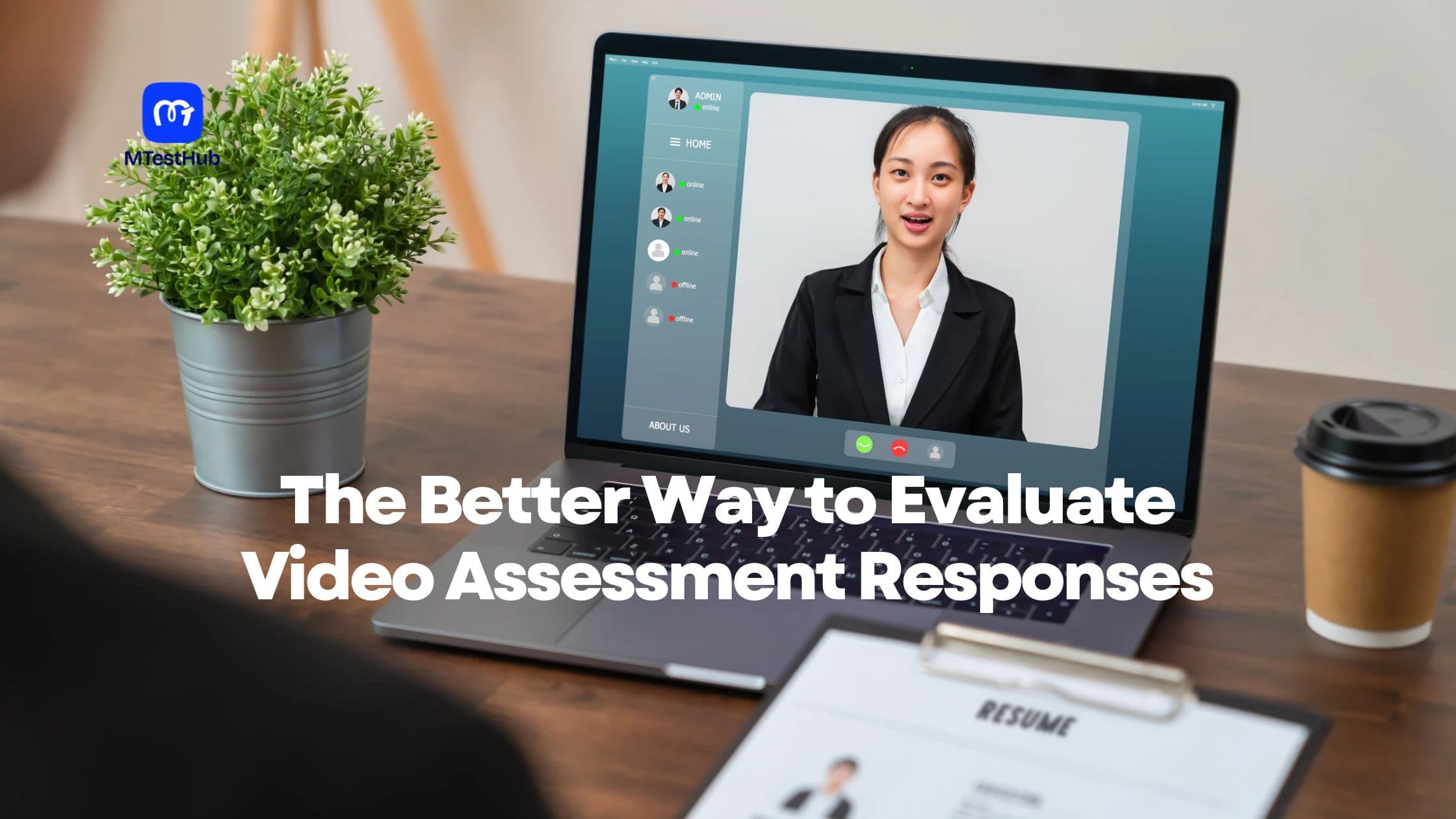

Video responses can be useful in hiring because some competencies are easier to demonstrate through explanation than through a multiple-choice question.
But video also creates a design challenge: what exactly should the system evaluate?
Our answer is straightforward.
Evaluate the job-related content of the response.
The MTestHub video-response model is designed around this sequence:
Record → Transcribe → Evaluate → Cite Evidence → Human Review
The candidate records a response to a defined question.
The media is securely processed and transcribed.
The transcript is evaluated against the question-specific rubric.
The scorecard shows the criterion scores, supporting evidence and — where available — timestamps that let the recruiter jump back to the original moment in the video.
The original video remains available to authorized reviewers according to the organization's retention policy.
A video assessment should not become an appearance assessment.
The AI scoring process should not use:
If communication is relevant to the job, the platform can evaluate the structure, clarity, completeness and substance of what the candidate says.
That is different from judging a person's physical or biometric characteristics.
If the transcript is the primary evaluation source, why retain the video at all?
Because evidence should be reviewable.
Transcription can be imperfect. Context can matter. A recruiter may want to verify a passage before making a decision.
A sensible model is limited media retention:
Organizations that prefer lower storage or stronger privacy controls can use transcript-first or transcript-only retention policies where the infrastructure supports them.
AI should never pretend to be certain when the input is poor.
If background noise, low audio quality or language detection makes the transcript unreliable, the system should flag the response for human review.
The recruiter can:
The original evaluation history should remain auditable.
A candidate can give an excellent response and still have an integrity event that deserves review. A candidate can also have perfect session integrity and give a weak answer.
Those should not be mixed into one opaque score.
MTestHub separates:
Performance — how the answer scored against the job-related rubric
from
Integrity Signals — events such as unusual focus changes or a possible additional speaker that may deserve human review
An integrity signal is context, not proof of misconduct.
Instead of trying to infer whether a candidate looked away from the screen, an AI-native assessment can test whether the candidate understands their own answer.
If the candidate says:
“I would review the account history before escalating.”
the system can ask:
“What specifically would you look for in the account history before deciding whether to escalate?”
That follow-up is based on the candidate's actual response and can validate depth of understanding.
This creates a more useful hiring signal than trying to interpret body language.
The ideal results view is simple:
Video | Transcript | AI Evaluation
The reviewer can watch the original response, read the transcript, inspect the rubric and see why the system awarded each score.
That is what explainable AI should look like in an assessment workflow.
MTestHub is building video assessment around job-related evidence, transparency and human review.
Sign up now to explore:
https://app.mtesthub.ae/signup
Be the first to know the latest hiring trends, product updates, and exclusive tips to streamline your recruitment process by joining our newsletter.


Streamlining Recruitment, Assessments, and Exams with AI-driven automation.
We use cookies to improve your experience. By continuing, you consent to their use. Do you accept?