
Learn why resume-led hiring no longer works in 2026, and what companies can do instead.

Content Marketing Manager
In 2010, a resume was a reliable summary of a professional life.
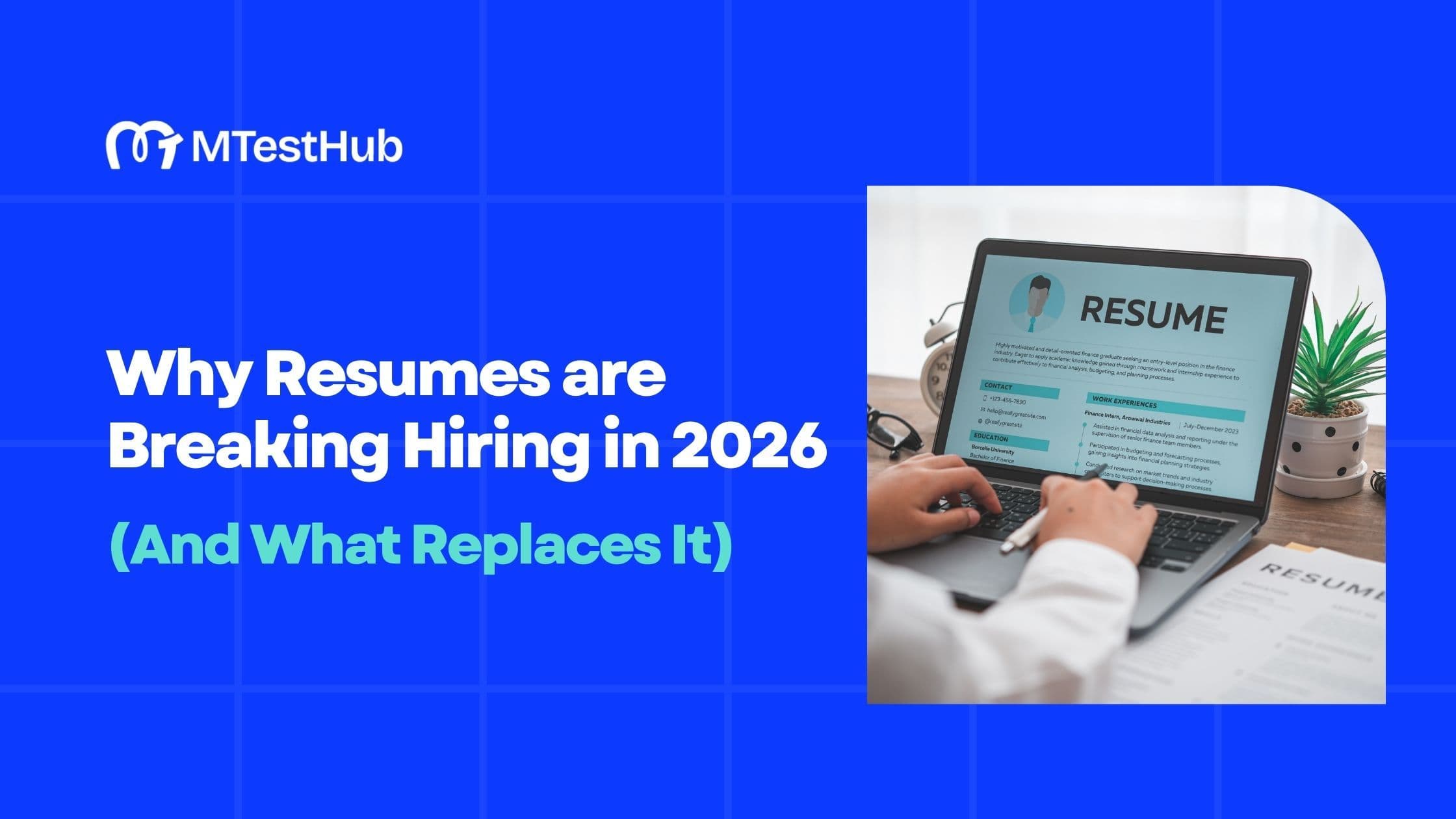
In 2026, a resume is often little more than a creative writing assignment graded by an algorithm.
For decades, the resume has been the currency of the labor market. It was the gatekeeper and the primary filter for talent acquisition. But as we settle firmly into the AI-native era, a harsh reality is hitting hiring managers across the globe: the resume is broken.
Hiring managers today are drowning in a sea of perfectly polished, keyword-optimized, AI-generated PDFs that tell them absolutely nothing about a candidate's actual ability to do the job.
If your hiring strategy still relies on manual resume screening as the first line of defense, you aren’t just losing time; you are actively breaking your recruitment funnel.
1. Your talent acquisition funnel cannot survive the hallucination of “perfect resumes”.
The democratization of Generative AI has fundamentally changed the job market, and it has leveled the playing field, but perhaps too much.
Five years ago, a typo or a poorly structured sentence on a resume might have indicated a lack of attention to detail.
Today, a candidate with zero writing skills can produce a Shakespearean cover letter in three seconds.
The result? Resume inflation.
When every candidate sounds like the perfect choice on paper, "excellence" becomes hard to determine.
Hiring managers can no longer distinguish between a candidate who actually possesses a skill and a candidate who knows the best prompt for an AI to describe that skill.
Reliance on resumes forces hiring managers into a manual game of ‘spot the bluff,' a reactive approach that stands in direct opposition to data-driven decisions.
This leads to the most expensive mistake in business: interviewing candidates who look great on paper but lack the fundamental competencies to perform.
2. Hiring strategies collapse under the weight of high-volume hiring and manual screening
Technology hasn't just made it easier to write resumes; it has made it easier to send them.
With the rise of automated bot applications, the barrier to entry for applying to a job has dissolved. A single job posting can receive 2,000 applications in 48 hours.
The math simply doesn’t work for manual screening: The average hiring manager spends 6 to 10 seconds scanning a resume.
To screen 1,000 applicants, a hiring manager would need 3+ uninterrupted hours of rapid-fire scanning.
But human attention is not infinite.
Manual screening processes inherently trigger fatigue and cognitive bias, often causing high-potential talent to be overlooked.
Conversely, sub-optimal candidates frequently bypass these legacy filters through sophisticated keyword optimization, leading to a direct decline in your quality of hire.
This is the efficiency paradox.
We have more access to talent than ever before, yet it has never been harder to find the right person.
3. The "credentials-first" approach sabotages talent acquisition
The reliance on credentials-based hiring is a fundamental flaw in the modern recruitment funnel.
If the resume is the map, skill-based assessment is the terrain.
By prioritizing backward-looking pedigree, like where someone went to school or who they worked for, over verified competency, recruiters are hiring for history rather than future performance.
This creates a massive disconnect between a candidate’s claims and their actual output.
In 2026, elite talent acquisition requires a shift to a skills-first hiring strategy. Relying on static resumes only clogs the pipeline with candidates who look the part but cannot play it, ultimately damaging your quality of hire.
To scale effectively, you must stop scanning for keywords and start validating potential through data-driven decisions.
Modern platforms like MTestHub exist to help organizations escape the obsolete, traditional method of hiring.
Instead of filtering by keywords, forward-thinking companies filter by competency.
Here is what the new, broken-resume-free workflow looks like:
Phase 1: The objective filter (Automated Screening)
Instead of a recruiter reading a CV, the candidate enters a workflow where their skills are validated immediately.
Hard Skills: A developer is given a coding challenge. An accountant is given a ledger analysis test.
Soft Skills: A customer service rep takes a situational judgment test.
This data is objective. It ensures bias-free hiring by ignoring the candidate's gender, university, or font choice. It only cares: Can they do the job?
Phase 2: Integrity in the age of AI (AI proctoring) You could ask:
"If candidates use AI to write resumes, won't they use AI to cheat on tests?"
This is where MTestHub separates itself. In 2026, proctoring is non-negotiable. MTestHub utilizes AI-powered proctoring that monitors for:
This restores the "trust mechanism" that was lost from over-reliance on resumes.
When a candidate passes a proctored assessment, you have verified proof of their capability, something the resume can no longer provide.
Switching from resume-first to assessment-first is an investment, but the ROI is clear.
1. Reduction in time-to-hire: By automating the initial screen, recruiters skip the "resume reading" phase entirely. This accelerates the pipeline and secures top talent before competitors do.
2. Data-driven decisions: Hiring becomes a science, not a guessing game. You move from "I have a gut feeling" to "The data shows they are in the top 10% for Python coding."
3. Improved quality of hire: When you hire for skills, you get employees who can hit the ground running. Retention rates improve because the person actually has the competency for the role.
The resume-first era is over. In a world defined by AI-generated content and mass applications, the manual review of static documents is a liability.
The companies that will lead their industries in 2026 are those that have embraced recruitment automation to secure elite talent through verified competency.
Ready to transform your recruitment funnel into a high-performance engine?
Leverage MTestHub to eliminate bias, reduce time-to-hire, and ensure every hire is backed by objective data.
Book a free demo to experience bias-free, data-driven hiring today.
Be the first to know the latest hiring trends, product updates, and exclusive tips to streamline your recruitment process by joining our newsletter.


Streamlining Recruitment, Assessments, and Exams with AI-driven automation.
We use cookies to improve your experience. By continuing, you consent to their use. Do you accept?